Performative protocols
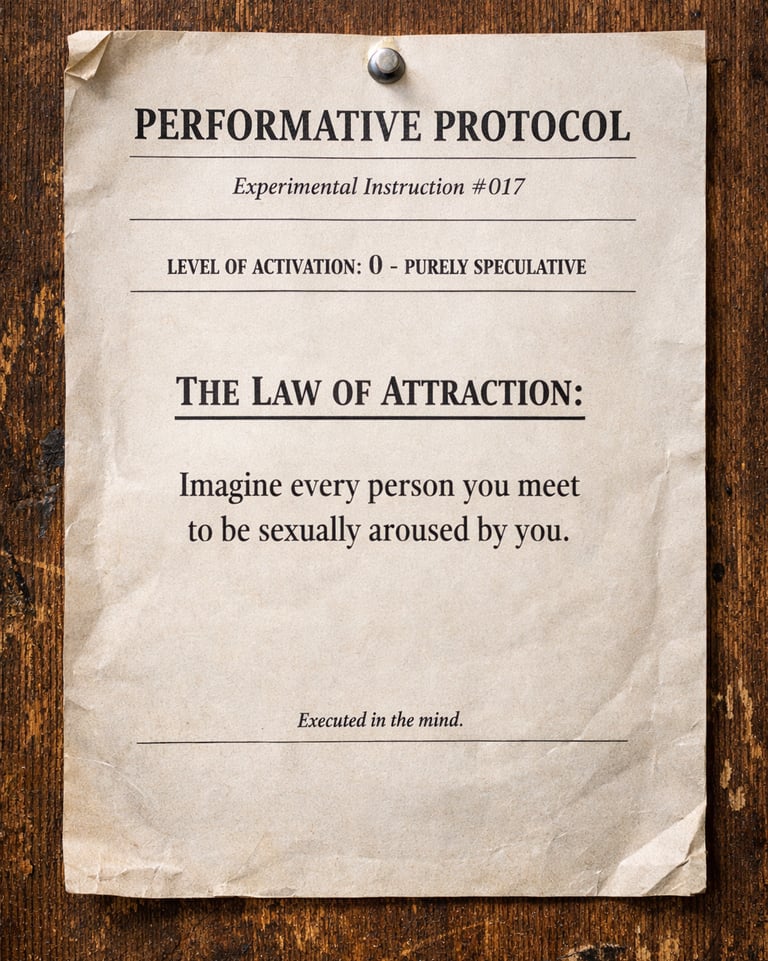
Performative protocols are frameworks for action that do not rely on persuasion, belief, or authority, but on form, repetition, and situational framing. They operate by borrowing the surface language of systems that already structure social life—administration, ritual, bureaucracy, instruction—while quietly displacing their function. A protocol does not tell participants what to think or feel; it establishes a set of conditions within which behaviour, perception, and meaning begin to reorganise.
At their core, performative protocols treat action as generative rather than expressive. What matters is not intention, sincerity, or conviction, but enactment: the fact that something is done, repeated, displayed, or staged within a recognizable frame. In this sense, a protocol functions less as a message than as an interface. It is read, handled, cited, or performed, and through this use it begins to operate. The effects it produces are often indirect, delayed, or disproportionate to the simplicity of the gesture that initiates them.
Rather than offering solutions or prescriptions, performative protocols function as instruments of inquiry. They make visible how legitimacy is staged, how authority is rehearsed, how norms are internalized, and how meaning stabilizes through use. They do not oppose existing systems directly; they operate alongside them, mimicking their logic at low intensity until the underlying mechanisms become perceptible. In this sense, the work is neither purely critical nor affirmative. It is diagnostic.
This field remains deliberately open and in development. The protocols are not presented as a closed system, but as an evolving cartography—one that traces how minimal actions, once framed and enacted, begin to exert influence. What is explored is not power as domination, but power as arrangement: the quiet force of formats, rituals, and repeated gestures that shape reality without announcing themselves as such.